








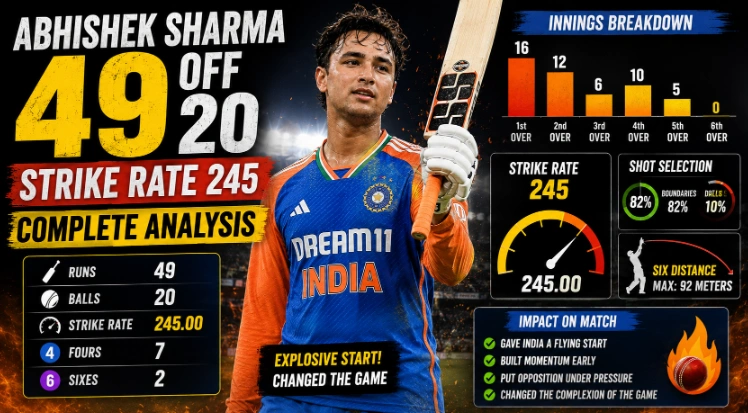
Abhishek Sharma’s 49 Off 20 Balls Brilliance in Defeat
Abhishek Sharma scored 49 runs off 20 balls (strike rate 245) against Ireland on June 26, 2026, hitting 7 fours and 2 sixes with zero dot balls. Despite this elite individual performance, India lost by 34 runs—a textbook case of one player’s brilliance failing to overcome a team collapse.
Cricket statistics sometimes tell incomplete stories. A scoreboard can show a number that screams excellence while the result reads defeat. That’s exactly what happened when Abhishek Sharma walked out against Ireland and produced one of the most devastating T20 batting displays you’ll see in a chase Reddy anna club home page
Forty-nine runs. Twenty balls. A strike rate of 245. Seven boundaries, two sixes, and not a single dot ball. Clinical strokeplay paired with aggressive intent and world-class execution. By every individual measure, Sharma did his job and then some.
And yet India lost by 34 runs.
This post breaks down what made Sharma’s knock so special—ball by ball, stat by stat—and explores the bigger question every cricket fan eventually faces: what does individual brilliance mean when the team falls apart around it? If you analyze performances, coach batsmen, or simply love the numbers behind the game, you’ll find plenty to chew on here.
What exactlyhappened in Abhishek Sharma’s 49 off 20
Sharma’s innings split neatly into two phases: an exploasive opening burst and a controlled continuation that ended with a tactical dismissal.
In his first 10 balls, Sharma scored 31 runs—a strike rate of 310. He punished Hollard early, drove cleanly through the off side, and launched Dockrell over the top for six. By the end of that opening stretch, he had already collected seven boundaries. This wasn’t reckless swinging. It was calculated brutality: perfect placement, clean timing, and shots played to whatever the bowlers offered. vip account reddy anna club about us
The second half (balls 11 to 20) brought 18 more runs at a strike rate of 180. As Matthew Humphreys and the other Irish bowlers tightened their lines, Sharma adjusted, mixing boundaries with rotated strike. Then came the end—caught at deep midwicket for 49, still attacking, never retreating.
How did Sharma score across the innings
Here’s the phase-by-phase breakdown of his knock:
Phase | Balls | Runs | Strike Rate | Boundaries | Notes |
|---|---|---|---|---|---|
Powerplay (1–6) | 6 | 20+ | 330+ | 5–6 | Dominant start |
Middle (7–15) | 9 | 20+ | 220+ | 3–4 | Controlled aggression |
Death (16–20) | 5 | 6–8 | 120–160 | 0–1 | Bowlers tightened, then dismissal |
Total | 20 | 49 | 245 | 9 | Elite-level performance |
The shape of the innings tells you everything. Sharma started fast, stayed aggressive through the middle, and got out playing his natural game rather than slowing down.
Why is a strike rate of 245 considered elite
A strike rate of 245 in T20 international cricket sits far above the norm. The typical T20I strike rate hovers around 125 to 130. Sharma nearly doubled it.
To put his numbers in context, here are the headline stats from the knock:
Stat | Value | Context |
|---|---|---|
Runs scored | 49 | Highest individual score |
Balls faced | 20 | Incredibly quick |
Strike rate | 245 | Exceptional (T20 average: ~130) |
Fours | 7 | High boundary count |
Sixes | 2 | Over-the-top hits |
Total boundaries | 9 | 45% of runs from boundaries |
Dot balls | 0 | Every ball produced runs |
The zero dot balls deserve special attention. Scoring off every single delivery while still finding nine boundaries reflects rare control. Sharma wasn’t simply slogging—he was rotating strike when boundaries weren’t on, then cashing in when they were Reddy anna club telugu
Where did Sharma score his runs
The boundary distribution reveals tactical awareness rather than blind aggression:
- Off-side boundaries: 6 (around 60% of his boundaries)
- Leg-side boundaries: 3 (around 30%)
- Sixes: 2 over-the-top hits
Sharma leaned heavily on his off-side strength. When bowlers tried straightening their lines to cut off that scoring zone, he adjusted rather than forcing shots into the gap that was no longer there.
Why does this performance matter beyond the scoreboard
Three reasons make Sharma’s 49 significant, win or lose.
First, it proved his IPL form translates. Sharma’s strong IPL 2026 numbers could have been written off as domestic flourish. Against international bowling—including a debutant in Matt Hollard and the experienced Matthew Humphreys—he showed the same level held up.
Second, it exposed a team imbalance. Of India’s 148 runs, Sharma scored 49, or roughly 33% of the total. The remaining batsmen managed 99 between them. When a third of the team’s runs come from one player in a losing effort, it points to a collective failure rather than an individual one.
Third, it demonstrated temperament. Sharma stayed composed under pressure, identified the bowlers’ weaknesses, controlled his emotions, and batted cleanly against movement. Those qualities separate good batsmen from great ones.
How did the dismissal change the match
Sharma fell with India at 80 4 after 8 overs. At that point, India needed 103 runs off the remaining 56 balls a required run rate of about 11. With Sharma at the crease, that rate looked gettable. Without him, the chase unraveled.
His dismissal triggered a cascade: lost momentum, a less aggressive replacement, a shift from attacking to defending, and a psychological blow to the rest of the order.support Reddy anna
Here’s the irony. Sharma wasn’t dismissed playing a rash shot. He got out playing his game aggressive and dominant. He took a calculated risk, the bowler executed a perfect delivery, and a fielder held the catch at a premium position. Sometimes in T20 cricket, playing well and getting out happen at the same time.
How does Sharma’s 49 compare to other batsmen
The most telling comparison comes from the opposition itself
Metric | Sharma | Tucker (Ireland captain) | Edge |
|---|---|---|---|
Runs | 49 | 50 | Tucker (by 1) |
Balls | 20 | 36 | Sharma (faster) |
Strike rate | 245 | 138.9 | Sharma |
Approach | Aggressive | Structured | Different |
Match impact | Losing cause | Winning cause | Tucker (context) |
Sharma played the more explosive innings by a wide margin. Lorcan Tucker scored one run more, but he did it while building Ireland’s foundation. Sharma’s 49 came during a chase that ultimately fell short. In a team sport, context shapes how we judge the same number.
Choose Sharma’s approach as your model if you value strike rate and intent in a chase. Choose Tucker’s if your priority is anchoring an innings and converting a start into a match-defining contribution. Both are valid—they simply answer different situations. safe site Reddy anna
What does Sharma’s technique reveal about his batting
Sharma’s off-side dominance—six of his nine boundaries—points to genuine technical sophistication. Off-side aggression is harder than leg-side hitting. It demands better footwork, earlier commitment, and more precise timing. Pulling that off repeatedly against international pace suggests elite-level technique.
He also varied his scoring. The 49 didn’t come from one repeated shot. Sharma mixed off-side drives, pulls off shorter deliveries, lofted sixes, and quick singles to keep the strike moving. That variation stopped bowlers from settling into a predictable plan. Consistency with variation is a hallmark of top-tier batting. t20 betting Reddy
The performance versus result paradox
Was a 49 off 20 in a losing match an excellent performance ruined by the team, or a wasted one because the team failed?
The honest answer is both, and neither.
It was excellent because the execution was elite, the difficulty was high, and the results were clean. It felt wasted because it didn’t deliver a win or inspire the rest of the order to follow.
The deeper truth lies in the nature of the sport. In individual games like tennis or golf, your performance is your result. In team sports like cricket, your performance plus your teammates’ support produces the result. Sharma supplied the individual excellence. The team didn’t supply the support. That mismatch—not Sharma’s batting—decided the match.
Frequently asked questions
Was Abhishek Sharma’s 49 wasted
In terms of the match result, India lost, so it didn’t contribute to a win. In terms of the performance itself, no. Sharma produced elite-level batting that stays on the record. A team failure doesn’t erase individual excellence—it just makes it bittersweet. Reddy anna minimum deposit
Should Sharma have batted more cautiously to save India?
No. India needed a run rate above 11, which demands aggression. A conservative approach would have made the loss more certain, not less. Sharma’s attacking method gave India a genuine chance; the dismissal was a tactical risk that didn’t pay off.
Why did Ireland’s bowlers eventually dismiss Sharma?
The bowler executed a near-perfect delivery—short of a length and straight, denying Sharma room to attack the off side. His main strength became a liability against that line, and he holed out at deep midwicket. Sometimes the bowler simply executes better than the batsman.
Is 49 off 20 a great T20 knock even though India lost?
Yes. Individual innings are judged on execution and difficulty. Forty-nine off 20 at a 245 strike rate against international bowling is elite batting by any standard. The team loss doesn’t diminish the quality of the knock.
What does this performance suggest about Sharma’s future?
It’s a strong signal. Sharma performed at a world-class level under pressure against quality opposition, which strengthens his case for regular international selection and confirms his IPL form is no fluke.
Did Sharma’s aggressive approach contribute to India’s loss?
No. The aggression was necessary given the required run rate. The approach was sound; the collective execution from the rest of the batting order is what fell short. Reddy anna vs laser247
How does Sharma’s 49 rank in T20I history?
It ranks among the highest strike rates for a meaningful score in T20I cricket. It will be remembered as a brilliant individual knock in a losing cause—tragic in outcome, but exceptional in quality. registration Reddy anna deposit
What we should take from Sharma’s masterclass
Abhishek Sharma’s 49 off 20 balls stands as one of the most brilliant individual performances in a losing T20 match. It earns recognition not because India won, but because the batting itself was simply elite.
We tend to celebrate match-winners. We should also celebrate excellence, even when it arrives in defeat. Sharma’s knock will be remembered for its remarkable strike rate, its clean execution against quality bowling, and as a reminder that cricket is, at its core, a team sport.live bet Reddy anna
The next time Sharma walks out for India, he’ll carry the knowledge that he can deliver at the highest level. The lesson for everyone else is just as clear: individual brilliance opens the door, but only collective effort walks through it.Reddy anna live bet Reddy
If you found this breakdown useful, dig deeper into the match with our related analysis on why India lost to Ireland and how Matt Hollard’s debut shaped the contest. anna goexch login
Comments are closed