






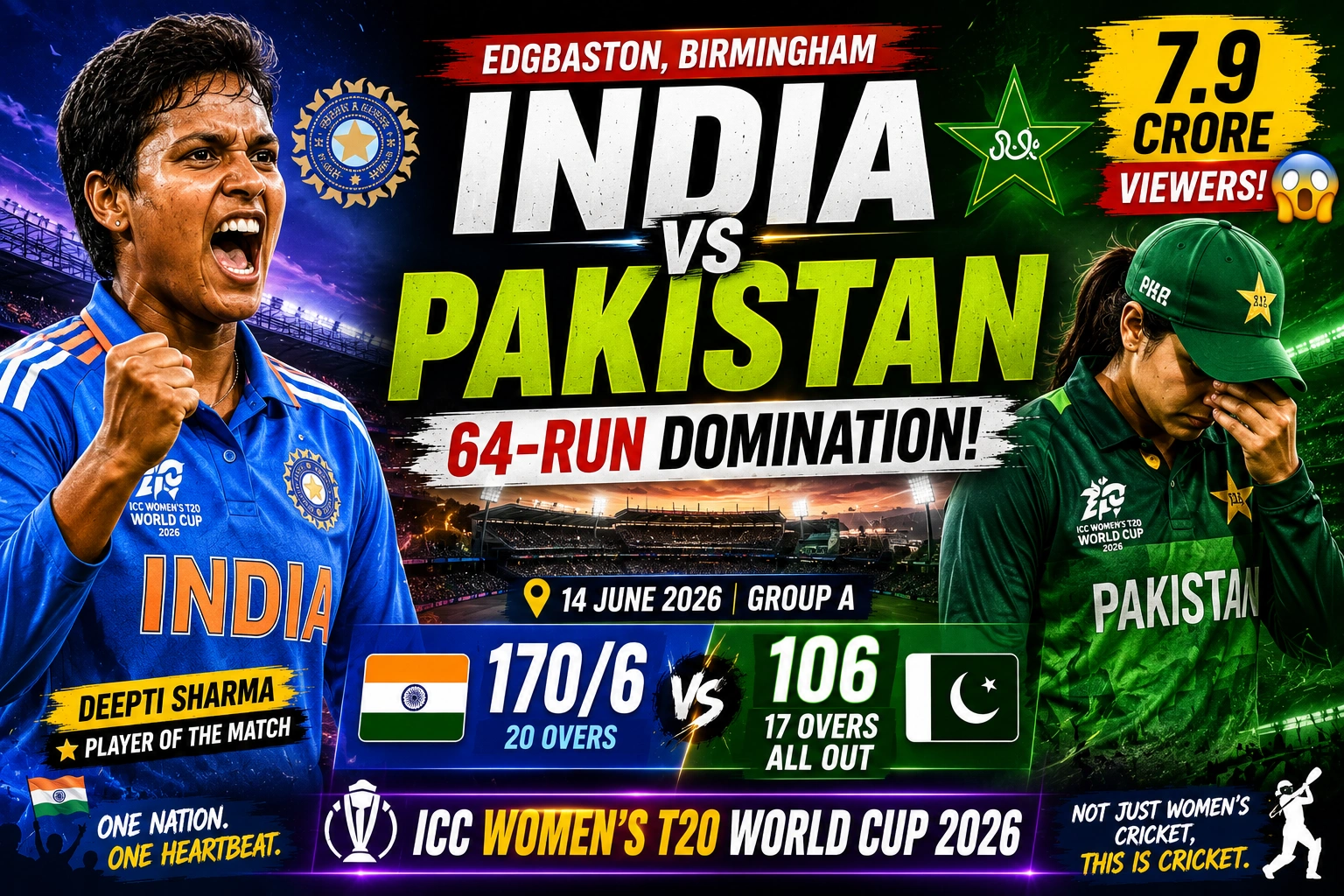
Edgbaston, BirminghamICC Women T20 World Cup 2026📖 10 min read⭐ POTM: Deepti Sharma

There is a moment in every India vs Pakistan match — men’s or women’s — where the whole country stops. Not stops what they are doing. Stops breathing.

It happens when a boundary cuts through the covers, or when a wicket falls at exactly the wrong time, or when the last over begins and both teams have everything to lose. In that moment, cricket becomes something bigger than sport. It becomes a shared experience — 1.4 billion people, one screen, one heartbeat.

For decades, that moment belonged exclusively to the men. Imran Khan vs Kapil Dev. Wasim Akram vs Sachin Tendulkar. Virat Kohli vs Mohammad Amir. These were the matchups that made India vs Pakistan feel like a lunar eclipse — rare, total, and unforgettable. The whole country quietly took a half-day off when these two teams met, without officially being told to.

But something has been quietly, permanently changing. Something the broadcasters noticed before the selectors did. Something the young girls watching from rooftops in Indore and Lucknow and Vadodara understood before the pundits acknowledged it.

The women have arrived. And on Sunday, 14 June 2026, at Edgbaston in Birmingham, that arrival was announced with a 64-run scoreline that shook Group A of the ICC Women T20 World Cup 2026 to its core.

🏏 Match Result — Quick Answer

India Women beat Pakistan Women by 64 runs in Match 6 of Group A, ICC Women T20 World Cup 2026, at Edgbaston, Birmingham on 14 June 2026. India Women scored 170/6 in 20 overs. Pakistan Women were bowled out for 106 in 17 oversDeepti Sharma was named Player of the Match. 7.9 crore (79 million) viewers watched live.

170/6India Women (20 Ov)
106Pakistan (17 Ov, Out)
64Winning Margin (Runs)
7.9CrLive Viewers
The Stage

Edgbaston, Birmingham — Why This Ground Was the Perfect Cathedral for This Moment

You couldn’t have written a better setting for this.

Edgbaston in Birmingham is not just a cricket venue. It is a cathedral of the sport. It has hosted Ashes battles of legendary tension, it carried the weight of multiple ICC tournaments, and it sits in a city with one of the largest South Asian diaspora communities in all of England. When India play at Edgbaston, the stands stop looking English entirely — they turn blue and saffron so completely that for a few hours, Birmingham feels like Wankhede.

For this match, add Pakistan green to that picture. Add the drums. Add the chants, the flags, the families who flew in from across continents to be inside that ground on this day. Add children who had never been to Birmingham before but will remember this afternoon for the rest of their lives.

And then add the context: this was not a bilateral series warm-up. This was a World Cup. Group stage. Points table. Every run mattered. Every wicket sent ripples through the tournament standings.

7.9 crore people chose to watch it. Not accidentally. They planned their Sundays around it, argued with family for the TV remote, refreshed scorecards in airports. India Women vs Pakistan Women had become the kind of fixture you simply cannot miss.

The Rivalry

Mard Ki Tarah Jalta Hai Dil — Why Women’s India vs Pakistan Now Burns Exactly as Bright

Let’s talk honestly about what makes India vs Pakistan different from every other cricket match on earth.

It is not just the history, though the history is extraordinary. It is not just the talent, though the talent on both sides has always been exceptional. It is something older than sport and more powerful than any scoreline — the fact that two nations sharing a border, a language, a cuisine, a culture, and the wound of Partition have poured all of that complex, painful, beautiful history into 22 yards of cricket pitch.

Every match carries 1947. It carries the weight of everything the two countries have been to each other: neighbours, rivals, estranged family who can’t stop watching each other across the fence.

“When Sachin walked out against Pakistan, a billion people stood behind one man at the crease. Today when Deepti Sharma runs in to bowl against Pakistan Women, the emotional weight is identical. The viewership numbers do not lie. 7.9 crore people confirmed it.”
Dimension Men’s India vs Pakistan Women’s India vs Pakistan 2026
Viewership Record-breaking crore figures 7.9 Crore — and growing
Venue atmosphere Nation holds its breath Nation held its breath
Emotional stakes India vs Pakistan = everything India vs Pakistan = still everything
Match intensity Every delivery felt deeply Every delivery equally felt
Star performers Sachin, Kohli, Wasim, Amir Deepti, Mandhana — same crowd roar
Cultural weight 1947 runs through every over Same 1947. Same weight. Same fire.

For years, the women’s game didn’t get this platform. No prime-time slots. No packed stadiums. No 7.9 crore viewers. No one treating Jhulan Goswami bowling with the same reverence given to Zaheer Khan.

That has changed. Fast. Completely. Permanently. Today when Smriti Mandhana walks out to open, she carries the same crowd roar Sachin used to carry. When Deepti Sharma runs in against Pakistan Women, hundreds of millions will every ball. The emotional architecture is identical. The stakes feel the same. The silences between deliveries carry the same weight.

India’s Innings

How Did India Women Score 170/6? Building a Target That Was Always Too Much

170/6 in 20 overs. In T20 cricket, a total at this mark sits on a very specific edge — not so dominant that the batting team can relax, and not modest enough for the chasing team to feel any margin for error.

India built it intelligently. Not with reckless slogging that makes highlight clips but unravels under pressure. With intent, craft, and a clear plan at every stage of the innings. The opening partnership gave India the platform they needed — calculated aggression that combined the intent to score with the discipline to pick the right delivery.

Match Context — India Women’s Innings

India Women posted 170/6 in 20 overs at Edgbaston. Built through measured partnerships, consistent rotation, and calculated acceleration in the death overs. No collapse, no panic. A professional batting performance on the World Cup stage against cricket’s most emotionally charged opposition.

The middle order showed exactly why this Indian batting lineup has become one of the most balanced in women’s T20 cricket globally. When wickets fell, the incoming batters rebuilt before accelerating. And those final 10–15 runs — the ones that pushed the total from 155 to 170 — were the runs that turned this from a competitive fixture into a statement of dominance. India knew what they were building. They built it with total control.

Player of the Match

Deepti Sharma: Why Does She Always Deliver the Biggest Performances on the Biggest Stages?

Deepti Sharma
All-Rounder · India Women Cricket Team
⭐ Player of the Match — ICC Women T20 World Cup 2026

If India Women’s rise in world cricket over the past decade has a human face, it belongs to Deepti Sharma. She doesn’t look like the traditional definition of a superstar. She doesn’t hit a hundred every match. She doesn’t carry the entire team on brute force. She doesn’t court controversy or dominate headlines between tournaments.

What she does is something rarer and far more valuable. She shows up. Not just turns up physically — she shows up the way champions do: ready, focused, and performing at a level above the occasion. Big game? Deepti delivers. India vs Pakistan at a World Cup? Deepti delivers. Player of the Match.

“The bigger the occasion, the calmer Deepti appears. The more the pressure builds, the better she performs. In a sport where nerves destroy good players, she operates in the opposite direction entirely.”

She is the complete T20 cricketer. Bats with judgment. Bowls with variation and control. Fields with the alertness that creates run-out opportunities opponents never see coming. When the team needs something important done in a tight moment, Deepti is who the captain turns to. When the game needs to be wrestled away from the opposition, she wrestles it. Player of the Match at the ICC Women T20 World Cup 2026. Nobody who has watched this team closely over the past five years was remotely surprised.

Pakistan’s Chase

Why Did Pakistan Women Score Only 106 Against India Women’s 170 at Edgbaston?

106 all out in 17 overs. The number sits on the scoreboard with no ambiguity. But what it doesn’t tell you is the story of how that gap — between India’s 170 and Pakistan’s 106 — became so large, so quickly.

Pakistan Women came to Edgbaston knowing exactly what India were capable of. Their coaching staff had done the analysis. Their squad carries genuine talent — individual players who, on their best day, can match anyone in world cricket. This was not a mismatch on paper. But what Pakistan needed Sunday was not just talent. They needed everything to go right simultaneously.

India’s bowlers from the very first over were disciplined, probing, and relentless. The field placements cut off easy runs. The variations — pace, line, length, slower ball — kept Pakistan’s batters constantly second-guessing. And when early wickets fell, the pressure that 170 had always promised to deliver began doing its heavy work. Every over that went by without enough runs saw the asking rate climb further beyond reach. 106 in 17 overs. Beaten by 64 runs. India earned every run of that margin.

The Numbers

Why Do 7.9 Crore Viewers Watching This Match Change Everything for Women’s Cricket?

Let’s stay with that number. 7.9 crore. 79 million people. A viewership figure of that scale for a women’s cricket match is not just a milestone — it is a complete demolition of every argument that ever tried to position women’s cricket as a smaller, quieter, less important version of the main sport.

79 million people didn’t stumble onto this match accidentally. They actively, intentionally chose to watch it. They planned Sundays around it. They argued with family for the TV remote. They watched on phones during lunch breaks at work. They were there because India Women vs Pakistan Women had become the kind of fixture you cannot miss.

For context: India vs Pakistan men’s matches at T20 World Cups draw viewership that makes advertisers weep with gratitude. The women’s game is now entering that same conversation. Not approaching it from a distance. Entering it. 7.9 crore for a group stage match should be framed in every BCCI boardroom that ever debated the commercial viability of women’s cricket. The viability is right there — 7.9 crore people confirmed it on one Sunday at Edgbaston.

The Bigger Picture

Women’s Cricket Is Not “Women’s Cricket” Anymore — It Is Simply Cricket

There used to be a reflex — and some people still have it, though fewer every year — to prefix everything about the women’s game with the qualifier. “Women’s cricket.” “Women’s World Cup.” As if the sport needed a separate shelf in the library, a sub-category of the real thing rather than the thing itself.

What happened at Edgbaston on 14 June 2026 was an argument against that reflex so powerful it barely needs words. What happened in Birmingham was cricket. Skilled, technically demanding, emotionally charged, high-pressure, World Cup cricket. India vs Pakistan with a packed stadium, electric atmosphere, 7.9 crore viewers, and a performance level that would have impressed in any format at any level of the game. None of that required a qualifying adjective to be true, significant, or celebrated.

The India Women’s team has been building toward this kind of moment patiently and persistently for years. Infrastructure investments in women’s domestic cricket. Increased bilateral exposure. Coaching upgrades. Growing media attention following performance. All of it produced a team playing with the confidence and maturity of a side that knows it belongs at the top of global cricket. Because it does.

And Pakistan Women, for all that they fell 64 runs short, are critical to what makes this rivalry so compelling. Great rivalries require two strong participants. Without the competitive, motivated, talented opposition that Pakistan Women bring to every India fixture, this would just be a match. With Pakistan in the opposite dressing room, it becomes the rivalry — the kind 7.9 crore people rearrange their Sundays to watch.

Looking Ahead

What India Women’s 64-Run Win Means for ICC Women T20 World Cup 2026

India Women now sit in a strong position in Group A. The win delivers the points, the net run rate, and — critically — the momentum of a team that has beaten their fiercest rival on the biggest available stage. In tournament cricket, momentum lives in how a team walks onto the ground, in the confidence with which a batter plays that difficult third ball of her innings.

India have that momentum now. The ICC Women T20 World Cup 2026 will have many more stories to tell. Other teams will have their moments. The later rounds will produce their own drama. Finals are always their own separate world with their own unfathomable pressure.

But on this Sunday in Birmingham — at Edgbaston, under grey English skies, in front of the blue and saffron and green crowd that made the ground feel like a festival — India Women reminded 7.9 crore people what they are made of.

170/6. 106 all out. 64-run win. Deepti Sharma, Player of the Match, already thinking about the next game. That is the story of Indian women’s cricket in 2026. And it has only just begun.

Frequently Asked Questions — India Women vs Pakistan Women T20 World Cup 2026

Who won India Women vs Pakistan Women in ICC Women T20 World Cup 2026?
India Women won the match by 64 runs. India scored 170/6 in 20 overs; Pakistan Women were bowled out for 106 in 17 overs at Edgbaston, Birmingham on 14 June 2026.
Who was Player of the Match in INDW vs PAKW T20 World Cup 2026?
Deepti Sharma was named Player of the Match in India Women vs Pakistan Women ICC Women T20 World Cup 2026 at Edgbaston, Birmingham.
What score did India Women post vs Pakistan Women in T20 World Cup 2026?
India Women scored 170/6 in 20 overs against Pakistan Women in the ICC Women T20 World Cup 2026 Group A match at Edgbaston on 14 June 2026.
How many runs did Pakistan Women score chasing India Women 170?
Pakistan Women were bowled out for 106 in 17 overs while chasing India Women 170/6 in the ICC Women T20 World Cup 2026 match at Edgbaston.
Where was India Women vs Pakistan Women T20 World Cup 2026 match played?
The match was played at Edgbaston Cricket Ground, Birmingham, United Kingdom on 14 June 2026. It was the 6th Match of Group A in the ICC Women T20 World Cup 2026.
How many people watched India Women vs Pakistan Women T20 World Cup 2026?
7.9 crore (79 million) people watched the India Women vs Pakistan Women ICC Women T20 World Cup 2026 match live, making it one of the most watched women’s cricket matches ever broadcast.
By how many runs did India Women beat Pakistan Women in T20 World Cup 2026?
India Women beat Pakistan Women by 64 runs in the ICC Women T20 World Cup 2026 Group A match at Edgbaston, Birmingham on 14 June 2026.
Is India Women vs Pakistan Women rivalry as emotional as the men’s rivalry?
Yes. The ICC Women T20 World Cup 2026 India vs Pakistan match drew 7.9 crore viewers, confirming that the women’s rivalry now carries the same national passion, emotional weight, and cultural significance as the men’s India-Pakistan cricket rivalry.

Published: 14 June 2026 · Updated: 15 June 2026 · Word Count: ~2,500 · Category: ICC Women T20 World Cup 2026

#INDWvPAKW #WomensT20WC2026 #DeepiSharma #IndiaWomen #ICCWomensT20WorldCup #CricketIndia #Edgbaston #TeamIndia #WomenInCricket #IndvPak

Leave A Comment

Your email address will not be published. Required fields are marked *